The World TodayArticle 07 of 12
The Profits of Catastrophe
When suffering becomes a market, who is accountable for what that market rewards?
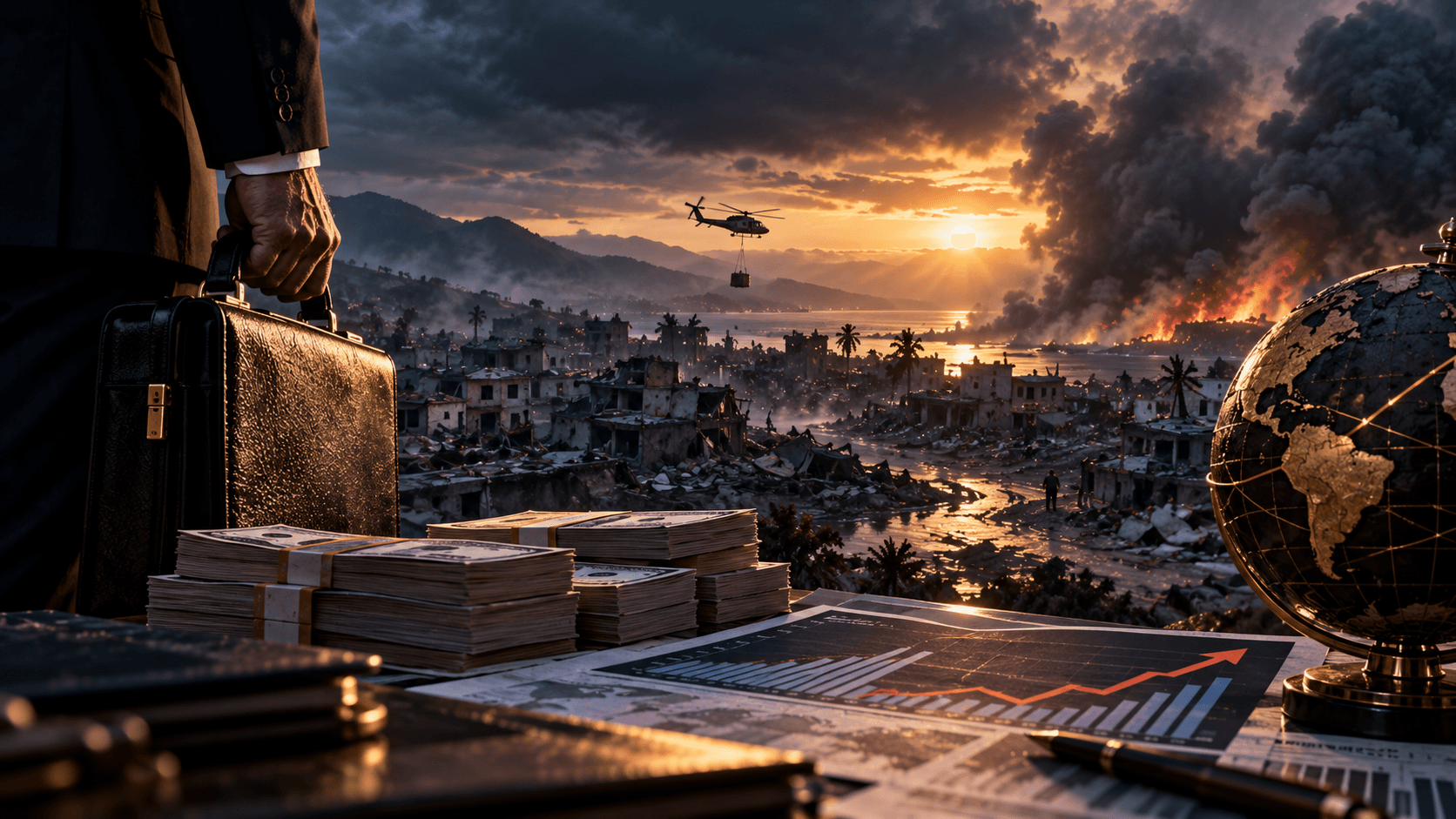
AI-generated illustration. Not a photograph of a real event.
For a family fleeing a war, the destruction of a home is a catastrophe. For a government, it is an emergency. For a supplier, it can be a contract. These realities can exist at the same time—but they should never be treated as morally equivalent.
Across the world, lives are being broken by conflicts whose costs reach far beyond the battlefield. Yet the machinery of crisis also moves extraordinary sums of money. Weapons must be manufactured. Fuel must be delivered. Buildings must be repaired. Emergency supplies must be purchased. The question is not whether those services are needed. It is whether a society in danger can still tell when necessity has become an opportunity for exploitation—and whether anyone with power is willing to stop it.
According to the Stockholm International Peace Research Institute, the world’s 100 largest arms-producing and military-services companies recorded $679 billion in arms revenue in 2024, the latest year covered in its 2026 Yearbook. That was a 5.9 percent increase over the previous year. Source 1 Revenue is not profit, and the figure does not demonstrate wrongdoing. It does establish something impossible to ignore: as wars and military fears grow, enormous commercial markets grow with them.
That is a conflict of incentives worth confronting, even when the equipment being purchased is necessary. A country under attack has every right to defend its people. Its soldiers need protection. But the public also has a right to ask who wins the contracts, how prices are set, who influences procurement decisions, and what happens to the institutions meant to provide scrutiny when urgency becomes permanent.
Consider the pressure created by the phrase “there is no time.” There may truly be no time to wait months for essential equipment. But there must still be time to record who received public money, what was delivered, and whether the price was defensible. Otherwise the emergency becomes more than a threat to national security. It becomes an exception to accountability—and exceptions have a way of becoming habits.
In February 2026, Ukraine’s National Anti-Corruption Bureau and Specialized Anti-Corruption Prosecutor’s Office reported allegations that a former defense official sought hundreds of thousands of dollars to influence a military housing tender. In April, the agencies announced the completion of an investigation involving alleged corruption in purchases of drones and electronic-warfare equipment. Source 3 Source 4 These were allegations and investigative findings, not convictions. Their importance lies in what they expose: even during an existential struggle, money intended for defense and shelter can become the object of private schemes.
Ukraine’s own anticorruption institutions brought those cases to light. That is evidence of accountability at work, not a reason to indict an entire country. Yet it also makes the broader warning harder to dismiss. If oversight is difficult in a functioning state fighting for survival, what happens where institutions are weaker, records are hidden, or the public has lost the ability to challenge those in charge?
An August 2026 audit by Ukraine’s Accounting Chamber identified procurement noncompliance involving contracts valued at nearly 350 billion hryvnias across the periods reviewed. More than 90 percent of the procurement value examined was conducted without competitive procedures. Source 5 That sum is not an estimate of money stolen. It is the value of transactions affected by audit findings. But the scale of the oversight concerns is substantial, and the distinction between an irregular process and a proven theft should sharpen the demand for investigation, not erase it.
The cost is also borne in budgets that never reach the battlefield. The International Monetary Fund examined how large increases in defense spending can add to deficits and debt, and how wartime buildups can coincide with falling real social spending. Source 2 A society may have to spend more to survive a threat. It may then have less available to strengthen hospitals, schools, housing, or the resilience needed for the next emergency. The bill arrives twice, and often the people who pay it have the least influence over the decisions.
Beyond government contracts, scarcity changes the balance of power in everyday life. When fuel is scarce, the cost of moving food rises. When housing is destroyed, the owner of the last available room holds leverage over someone with nowhere else to sleep. When a hospital urgently needs medicine, the ability to delay or withhold supply can become a form of power. Some price increases reflect genuine costs; others may exploit desperation. The point is that the buyer’s freedom to refuse is disappearing.
And that is where catastrophe becomes an ethical test. We can accept that businesses must operate, workers must be paid, and suppliers must recover real costs. We should not accept that the absence of alternatives makes every price fair, that national security makes every contract unquestionable, or that the scale of a crisis excuses every failure to investigate abuse.
It is tempting to imagine profiteering only as a conspiracy of powerful people behind closed doors. Sometimes misconduct is deliberate, and it must be proved case by case. But the more pervasive danger requires no secret meeting. It grows when institutions reward speed without scrutiny, access without competition, influence without disclosure, and commercial success without asking what human conditions made it possible.
If prolonged conflict means recurring revenue for some businesses, that does not prove those businesses want war to continue. It does mean the public deserves safeguards against incentives that could pull commercial interests away from the urgent human interest in peace. The burden should not fall on displaced families or exhausted taxpayers to prove why accountability matters.
The warning is not that earning money during a crisis is wrong. The warning is that a world can become so accustomed to monetizing emergency that it forgets whose emergency it was in the first place. Every contract has a beneficiary. Every budget has a trade-off. Every failure of oversight has someone who bears the cost.
If we wait until a crisis is over to ask who profited, who was exploited, and who could have intervened, we may discover that the systems meant to protect people learned to protect the flow of money first. The question cannot be left for the aftermath. It belongs at the beginning, while choices can still be changed.
Sources and reporting notes
Sources and reporting notes
Reporting cutoff: 25 October 2026. Company revenues are not profits; procurement noncompliance is not synonymous with theft; investigative allegations are not convictions. Figures refer to the periods stated by their sources.
Source links open in a new tab.
- 1
SIPRI, Yearbook 2026 Summary, arms industry revenues (2024 data)
https://www.sipri.org/sites/default/files/2026-06/yb26_summary_en_1.pdf (opens in a new tab)
- 2
IMF, World Economic Outlook, April 2026, defense spending and fiscal trade-offs
https://www.imf.org/-/media/files/publications/weo/2026/april/english/text.pdf (opens in a new tab)
- 3
NABU, Military housing corruption investigation, 19 February 2026
- 4
NABU, UAV and electronic-warfare procurement investigation, 17 April 2026
- 5
Accounting Chamber of Ukraine, Defense procurement compliance audit, 27 August 2026