The World TodayArticle 05 of 12
When the Earth Joined the Crisis
As fires spread, oceans warmed and ice retreated, the world confronted another kind of instability—one that could not be negotiated into a ceasefire.
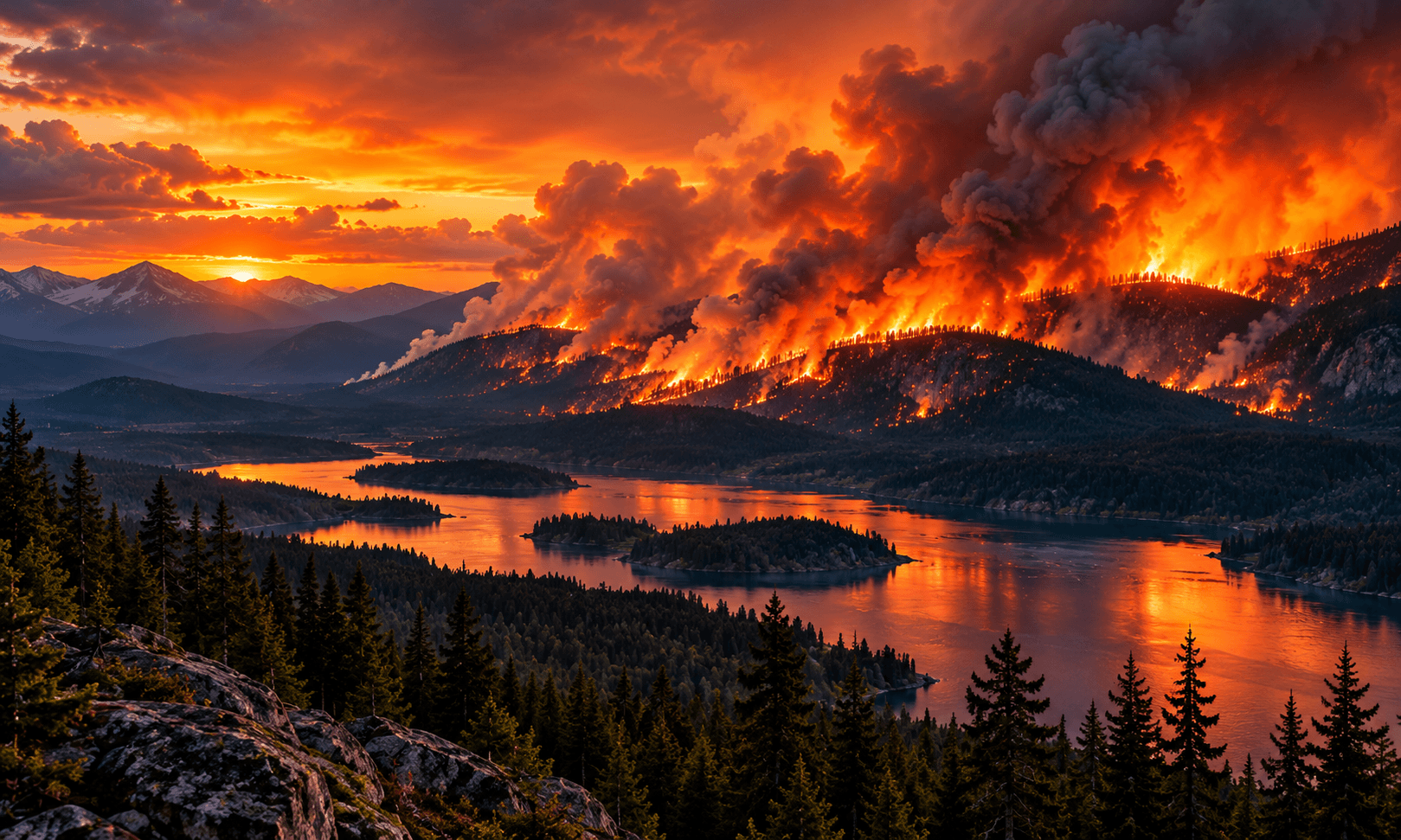
AI-generated illustration. Not a photograph of a real event.
For thousands of Canadians in 2026, the warning arrived as smoke. It settled over roads, moved across communities and turned familiar summer skies into a reminder that a home can become dangerous long before the flames reach its door.
By October 15, the federal government reported more than 5,400 wildfires and approximately 4.5 million hectares burned across Canada that year. More than 33,750 people had been forced from their homes, including over 8,800 people from First Nations communities. The Northwest Territories accounted for more than a third of the burned area. The season was not a national record. It did not need to be. For those packing belongings into vehicles, the distinction offered little comfort. Source 1
Fire has always belonged to the natural world. Lightning ignites forests; landscapes regenerate through cycles of burning and regrowth. But the danger posed by fire is shaped by more than ignition. Heat dries vegetation. Drought removes moisture from soil and trees. Wind carries embers across roads and rivers. The places where people build, the way forests are managed and the resources available to fight fires can decide whether a dangerous season becomes a catastrophe.
And the conditions do not stop at a national border. In 2026, researchers examining wildfire weather in Canada and in France and Spain reported how a warming climate can intensify the combination of heat, dryness and other conditions that favor severe fires. These studies assessed particular events and regions, not every fire everywhere. Source 2 The distinction matters: a global story becomes more credible, not less, when it refuses to turn every burning forest into the same event.
The deeper warning lay in what was happening beyond the flames. In March, the World Meteorological Organization reported that 2015 through 2025 were the eleven warmest years in the instrumental record. Ocean heat content had reached a new high in 2025, continuing a succession of records. The ocean was absorbing enormous amounts of excess heat, quietly storing changes that could influence coastlines, marine ecosystems and weather far from where the heat first entered the water. Source 3
That ocean heat is not a distant scientific abstraction. Warmer water expands. Land ice melting into the sea adds more water. Higher seas change the starting point for storm surge and coastal flooding. The WMO reported that global mean sea level in 2025 stood about eleven centimetres above its 1993 level. Eleven centimetres sounds small until it is added to a high tide, a storm, a vulnerable road or a neighborhood already close to the water. Source 3
At the other end of the world, the retreat of ice continued to offer its own evidence. In September 2026, scientists at the National Snow and Ice Data Center estimated the Arctic summer sea-ice minimum at 4.60 million square kilometres, tied for the tenth-lowest extent in nearly forty-eight years of satellite observations. Every one of the twenty lowest minima occurred within the last twenty years. Source 4 The figures do not mean the Arctic vanished that summer. They show a long-running transformation that no single cooler season reverses.
The planet has natural rhythms, and ignoring them would make this account incomplete. El Niño and La Niña alter rainfall, temperature and atmospheric circulation. Volcanic eruptions can temporarily cool the climate; solar variations and ocean cycles also matter. Natural variability helps explain why one region floods while another suffers drought, and why a particular year may depart from a longer trend. But natural cycles are not an adequate explanation for the observed multidecade warming. The weight of scientific evidence identifies human greenhouse-gas emissions as its dominant cause. The two realities coexist: natural forces shape the weather we experience, while human activity has shifted the background conditions in which those forces operate. Source 3Source 5
And sometimes the human consequences are magnified by decisions that have little to do with atmospheric physics. A flood becomes more destructive when homes occupy floodplains without protection. A drought becomes a food emergency when families have no savings, irrigation or secure supply routes. A heatwave becomes deadlier when electricity fails or healthcare is already overwhelmed. Researchers studying floods in Assam in August 2026 emphasized exposure and structural vulnerability even as rainfall trends remained uncertain. Source 2 The hazard matters. So does the society it strikes.
Imagine the timing, not as a prediction but as a test of our assumptions: a major fire season while emergency budgets are strained; destructive flooding while roads and bridges are needed for relief; a coastal storm while fuel and construction materials are expensive because of conflict overseas. Each emergency might be survivable on its own. Together they could exhaust the very systems built to contain them.
This is where environmental instability joins the wars, hunger and political tensions explored in the earlier articles. Firefighters, hospitals, electrical grids, ports and food distributors do not exist in separate worlds. They depend on the same roads, fuel, communications, money and public trust. When those dependencies are disrupted, distance becomes less protective and recovery becomes slower.
None of this requires the Earth to erupt in some unprecedented, synchronized convulsion. There is no established scientific evidence that earthquakes or volcanic eruptions are accelerating worldwide in the manner of an apocalyptic film. The documented threats are serious enough without inventing a new planetary mechanism. What deserves attention is the accumulating pressure of hazards we can already measure, arriving in a world whose capacity to respond is uneven and sometimes dangerously thin.
For a family leaving a fire-threatened community, the crisis begins with an evacuation order. For a fishing town, it may begin with warming waters and a livelihood that no longer behaves as it once did. For a coastal resident, it may begin with one more flood that reaches a little farther than the last. These are different stories, connected by a simple truth: the environment is not a backdrop to human affairs. It is part of the foundation on which those affairs depend.
Humanity cannot negotiate with a drought, threaten a rising sea into retreat or persuade a forest not to burn. But it can decide how much danger to create, how much vulnerability to tolerate and how prepared to be when the next emergency arrives.
The Earth did not have to turn against us. It was enough that we kept asking an increasingly strained world to absorb one more crisis.
Sources and reporting notes
Reporting cutoff: 25 October 2026. The 2026 WMO report cited here summarizes measured conditions through 2025; the wildfire and Arctic sea-ice figures are observations reported during 2026. Event-attribution findings apply to specified events and should not be generalized to every disaster.
Source links open in a new tab.
- 1
Public Safety Canada, “Government of Canada provides an update the 2026 wildfire season,” 15 October 2026.
- 2
World Weather Attribution, 2026 event studies, including Canadian wildfires (6 August), France and Spain wildfire conditions (30 July), and Assam floods (14 August).
https://www.worldweatherattribution.org/by-year/ (opens in a new tab)
- 3
World Meteorological Organization, State of the Global Climate 2025, released 23 March 2026.
- 4
National Snow and Ice Data Center, “Arctic sea ice has reached minimum extent for 2026,” 23 September 2026.
- 5
Environment and Climate Change Canada, Extreme weather event attribution: scientific methodology and attribution framework.