The World TodayArticle 02 of 12
The Day the Pacific Changed
In the waters around Taiwan, the distance between pressure and war is becoming dangerously difficult to measure.
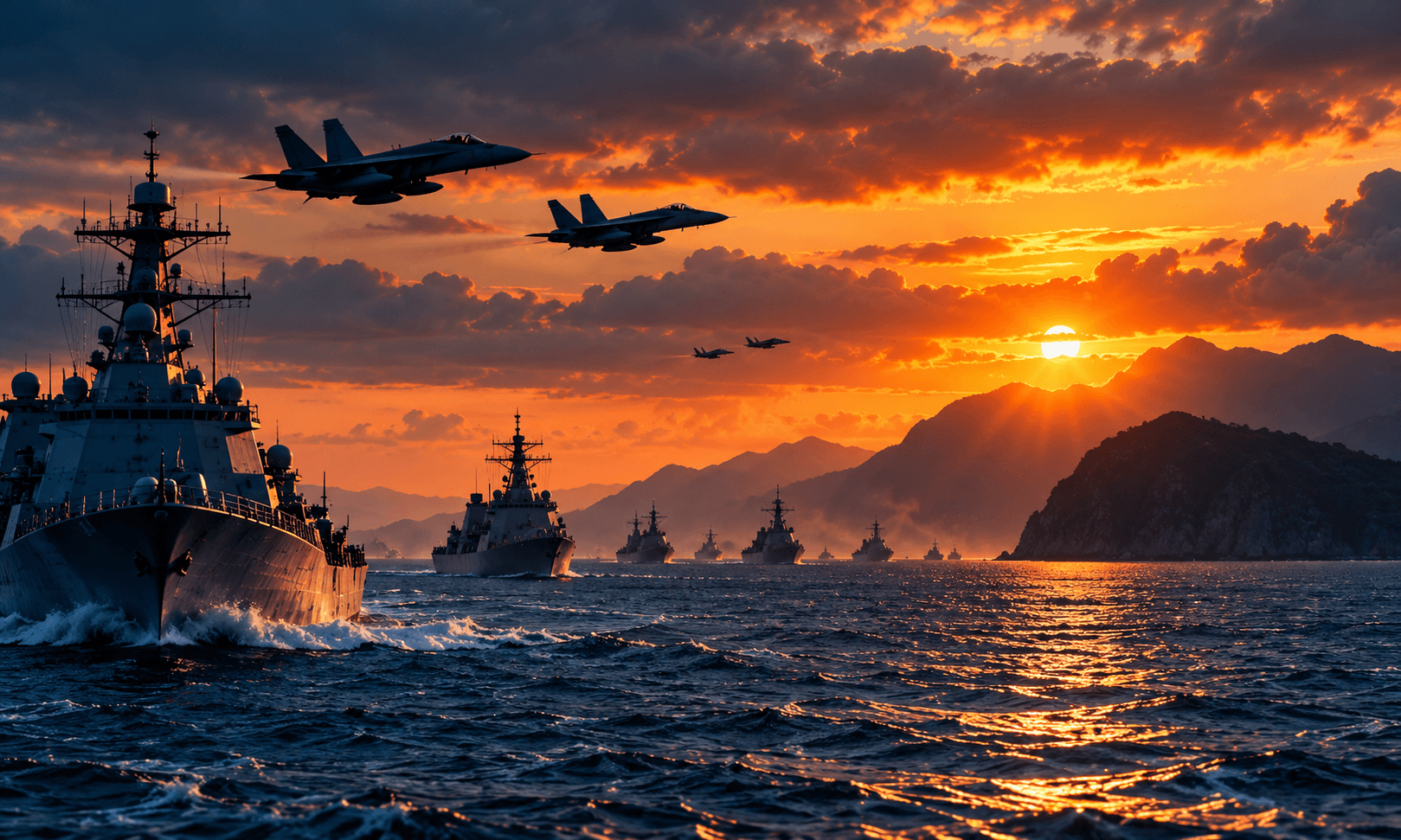
AI-generated illustration. Not a photograph of a real event.
In August 2026, Taiwan’s navy and coast guard rehearsed a task that sounded ordinary until its purpose was explained: escorting a merchant ship through a simulated blockade. A minesweeper cleared a safe passage. Other vessels guarded the route. The exercise was designed for a future in which a commercial ship might no longer be able to reach the island without military protection. Source 1
The ships were practicing for a conflict that had not begun. Yet the need to rehearse it said something about how the Western Pacific had changed. The danger was no longer confined to a hypothetical invasion force assembling across the Taiwan Strait. It also lived in patrol routes, maritime restrictions and the possibility that one government could gradually make another’s access to the outside world conditional on its permission.
Beijing claims Taiwan as part of China and reserves the option of force to achieve unification. Taiwan governs itself and rejects Beijing’s sovereignty claims. The United States has long maintained an intentionally complex position: opposing unilateral changes to the status quo, supporting Taiwan’s defensive capacity and leaving the precise circumstances of possible military intervention uncertain. That ambiguity is meant to discourage war. In a crisis, it could also leave adversaries guessing about where the boundaries lie.
By June, Chinese coast guard vessels had begun regular patrols east of Taiwan, a development Taiwanese officials viewed with particular concern. The eastern approaches matter because they lead toward the open Pacific, away from the narrow strait separating Taiwan from the Chinese mainland. A presence there suggested a pressure campaign that was not limited to the familiar waters between the two shores. In October, the head of a commission appointed by the US Congress called those patrols destabilising; Beijing maintained that its activities were lawful. Source 2
The competing descriptions were themselves part of the struggle. One side spoke of law enforcement in waters it claimed. The other saw an attempt to normalize control that it did not recognize. The same ship could be presented as a routine patrol, an assertion of sovereignty or a rehearsal for coercion. And every repetition risked making an extraordinary level of confrontation appear ordinary.
That is what makes a blockade—or a more limited maritime quarantine—such a dangerous possibility. An amphibious invasion would be unmistakable in its scale and preparation. A restriction on shipping could begin with warnings, inspections, exclusion areas or selective interference. Each move could invite a response calibrated to avoid war, until a captain, coast guard officer or military commander faced a decision too immediate for careful diplomacy.
The consequences would not stop at the shoreline. Taiwan is deeply integrated into global technology supply chains, particularly advanced semiconductors. The United States’ own 2026 intelligence assessment warned that a conflict could disrupt access to critical technology and inflict severe economic costs even without American military intervention. A confrontation could therefore reach factories, hospitals, vehicles and communications systems thousands of kilometres from the first encounter at sea. Source 3
Nor would Taiwan be the Pacific’s only point of danger. The South China Sea is crowded with overlapping territorial claims, coast guard vessels and fishing communities whose livelihoods depend on disputed waters. China and the Philippines have repeatedly contested access to reefs and shoals. The Philippines is a US treaty ally. A maritime incident involving it could force governments to weigh obligations and credibility against the danger of a much larger conflict. Source 3
Farther north, another unresolved war has never been formally ended. On October 3, North Korea launched a ballistic missile that South Korea’s military said travelled more than 700 kilometres toward the sea east of the peninsula. Japan also monitored the launch. Pyongyang described the test as a demonstration of its capabilities; claims about the missile’s advanced performance were not independently established. Source 4
North Korea’s missile program, the presence of American forces in South Korea and Japan, and the military capabilities of China, Russia and the United States make this region unusually sensitive to miscalculation. A crisis in the Taiwan Strait would not automatically produce a second war on the Korean Peninsula. But it could consume diplomatic attention, complicate military planning and leave neighboring governments trying to interpret one another’s movements under intense pressure.
Japan, meanwhile, must consider both the security of its own islands and the consequences of any confrontation involving the United States. Its choices would be consequential even if it sought to avoid direct fighting. The same is true of governments across Southeast Asia, which depend on maritime commerce while navigating competing relationships with Beijing and Washington. The region is not a single bloc waiting to choose a side. It is a network of countries with different histories, interests and vulnerabilities, all exposed to the possibility of disruption.
There is an important distinction between preparation and intention. In March, US intelligence assessed that Chinese leaders had no fixed timetable for unification and were not then planning an invasion in 2027. It also assessed that Beijing preferred to achieve its objectives without force if possible, while continuing to develop military options. Source 3 This is not evidence that conflict is inevitable. It is evidence of something more complicated: an increasingly capable military operating inside a political dispute that remains unresolved.
What should trouble the world is not the certainty of a coming Pacific war. It is the number of ways a confrontation could begin without anyone announcing that war was the objective. A ship stopped for inspection. An aircraft intercepted too closely. A warning ignored because the other side has issued so many before. A government convinced that backing down today will invite something worse tomorrow.
In an interconnected world, the first people to feel such a crisis might be sailors and coastal communities. Soon afterward, it could be factory workers waiting for components, families confronting higher prices, and governments discovering that the supply chains on which they rely are also lines of strategic vulnerability.
The Pacific has not become a general battlefield. But it has become a place where the machinery of confrontation is practiced, repeated and gradually made familiar. History offers no guarantee that every rehearsal will remain a rehearsal.
And that is the warning: the world may recognize the beginning of a wider crisis only after the choices that could have prevented it have already narrowed.
Sources and reporting notes
Reporting cutoff: October 25, 2026. The article distinguishes actual exercises, patrols and missile tests from possible escalation. US intelligence judgments are assessments, not guarantees. The headline is thematic; it does not report a completed regional war.
Source links open in a new tab.
- 1
Reuters, “Taiwan holds naval drill during war games as China steps up maritime pressure,” August 13, 2026.
- 2
Reuters, “Chinese patrols to Taiwan’s east are destabilising, US Congress-appointed official says,” October 20, 2026.
- 3
Office of the Director of National Intelligence, Annual Threat Assessment, March 18, 2026, pp. 22–23.
- 4
Reuters, “North Korea fires ballistic missile toward sea, South Korea and Japan say,” October 3, 2026.