The World TodayArticle 03 of 12
The Fracturing of Europe
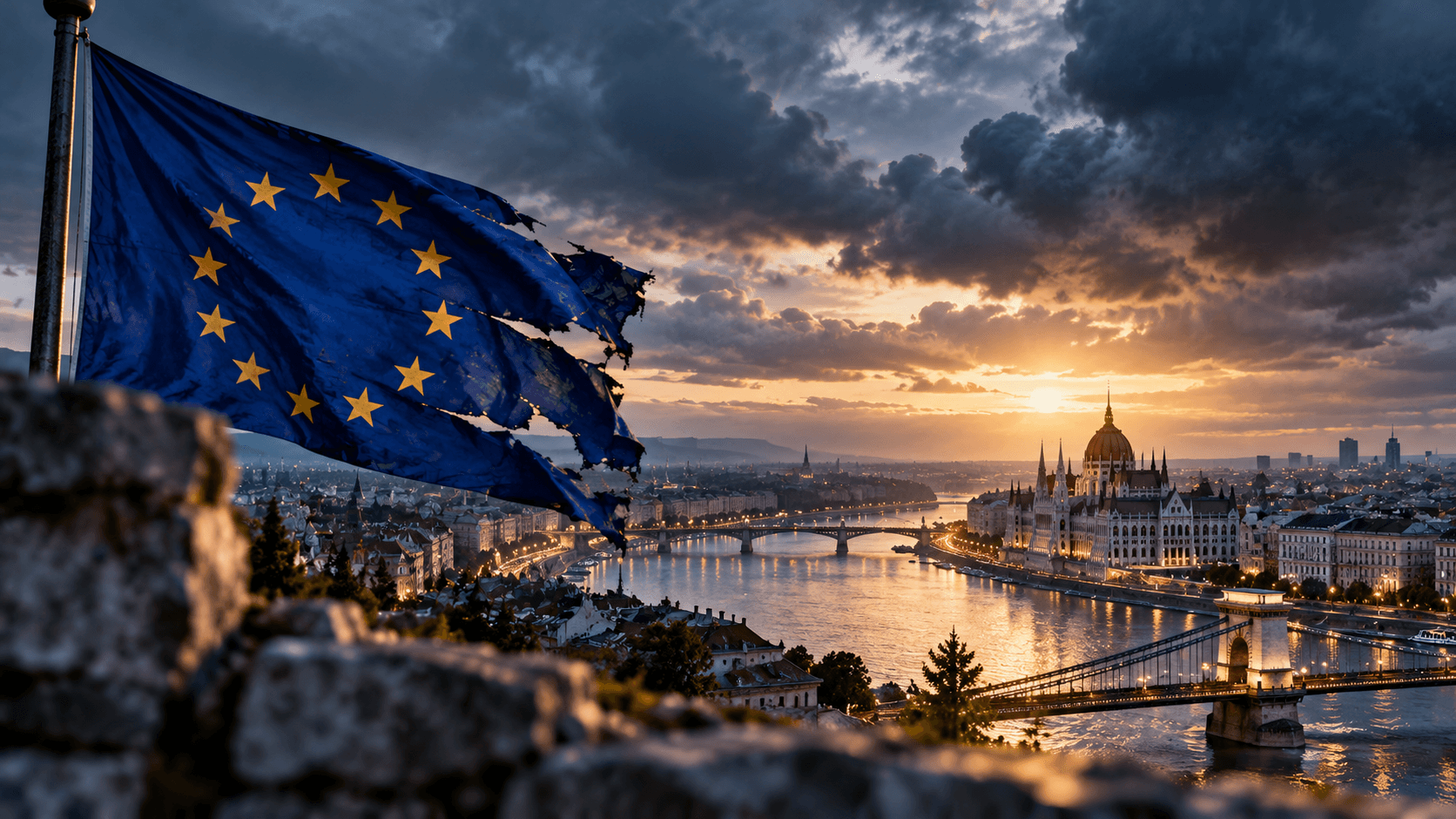
AI-generated illustration. Not a photograph of a real event.
Europe built institutions to ensure its wars would never again consume the continent. In 2026, the question was how much pressure those institutions could bear.
In Brussels, on October 15 and 16, Europe's leaders gathered to discuss matters that once might have occupied separate summits: a war on the continent, the cost of energy, the defense of borders, migration, and the money needed to hold the European project together. The agenda itself told a story. Security was no longer one policy among many. It was beginning to shape almost every other decision. Source 1
The European Union had not collapsed. Its governments still negotiated, legislated, traded and disagreed within institutions that had endured decades of upheaval. But the familiar rhythm of those disagreements was changing. When budgets were contested, leaders were not merely arguing over economic priorities. They were also weighing the price of protecting infrastructure, reinforcing frontiers and helping a country at war survive another winter.
Ukraine was at the center of the reckoning. Russian attacks on its energy and transport systems threatened civilian life and the basic functions of the state. The fighting also reached outward through the Black Sea, where attacks on shipping and agricultural export infrastructure raised concerns far beyond Ukraine's borders. European leaders condemned incidents affecting commercial vessels near Bulgaria and Romania and warned that damage to grain transport could undermine food security in Africa, Asia and the Middle East. Source 2
A ship damaged near a European coastline can be more than a maritime incident. It can become a question for insurers, port operators, naval commanders and governments deciding how far to respond. Every response carries a cost. Every failure to respond can carry one too. This is the uncomfortable territory in which a local act of violence can test an entire alliance's judgment.
Nor did the pressure stop at sea. European officials described intensifying hybrid threats: sabotage, drone incursions, suspected interference and attacks intended to disrupt societies without necessarily crossing the threshold into declared war. At the October summit, leaders called for faster work on drone defenses, border readiness and the protection of critical infrastructure. Source 1Source 2 These were not declarations that Europe had entered a general war. They were signs that the boundary between peacetime administration and wartime preparation had become harder to draw.
And still the ordinary obligations of government remained. Families needed affordable electricity. Businesses needed predictable costs. Public services needed funding. The same governments asked to spend more on defense were being asked to keep their economies competitive and their communities secure. The European Parliament's account of the summit described deep divisions over the Union's next long-term budget, with an agreement by year's end in doubt. Source 3
This is how institutional strain accumulates. Not necessarily through a single dramatic rupture, but through competing demands that each seem urgent and each require the same finite reserves of money, trust and political patience. A country on the eastern frontier may see military readiness as the first obligation of government. Another, struggling with energy costs or public anger, may see the immediate needs of households as equally non-negotiable. Both can be responding to genuine dangers. Their disagreement can still slow a collective response.
Europe's fault lines extend beyond the war in Ukraine. The Western Balkans continue to carry unresolved questions of sovereignty and identity. Moldova faces persistent security concerns while pursuing closer European integration. Migration pressures, nationalist politics and debates about democratic authority test the willingness of member states to accept decisions made together. None of these tensions means that European unity is an illusion. It means unity is work, repeated under conditions that are becoming more demanding.
There is another side to the 2026 record that makes the danger more revealing. Even amid these pressures, the Union was taking steps to expand. In October, the EU opened further accession negotiations with Ukraine and Moldova, and leaders continued discussing enlargement and defense cooperation. Source 4 Europe was not simply retreating into national survival. It was trying to enlarge a common political future while preparing for threats that could undermine it.
That simultaneous ambition and anxiety is the heart of the European predicament. Cooperation is most necessary when circumstances make it hardest. Every state has its own electorate, history and fears. Yet missiles, energy networks, shipping lanes, cyber systems and financial markets do not respect those distinctions. A decision delayed in one capital may change the options available in another.
The danger, then, is not that disagreement will inevitably destroy the European Union. Democratic disagreement is part of what the Union was built to accommodate. The danger is that crises may begin to arrive faster than institutions can reconcile their differences—and that the resulting delays could encourage further tests from those who believe Europe will hesitate.
There was no single moment in October 2026 when Europe broke. There were meetings, communiqués, negotiations, warnings and plans. The machinery was still moving. But the strain on it was visible, and the consequences of failure were no longer abstract.
A continent that remembers what happens when neighbors stop trusting one another was being asked, once again, to prove that cooperation could survive fear. The question was not whether Europe still possessed institutions strong enough to meet in Brussels. It was whether those institutions could act quickly enough when the next emergency arrived somewhere else.
Sources and reporting notes
Reporting cutoff: 25 October 2026. The article describes documented pressures and institutions; it does not assert EU collapse or inevitable European war. The EU Council is a primary source for its own positions, not independent verification of every allegation it makes.
Source links open in a new tab.
- 1
European Council, meeting of 15–16 October 2026.
https://www.consilium.europa.eu/en/meetings/european-council/2026/10/15-16/ (opens in a new tab)
- 2
European Council conclusions, 15–16 October 2026 (security, Ukraine, Black Sea and hybrid threats).
https://www.consilium.europa.eu/en/meetings/european-council/2026/10/15-16/ (opens in a new tab)
- 3
European Parliamentary Research Service, Outcome of the European Council meeting of 15–16 October 2026.
- 4
Council of the EU, October 2026 press releases on accession negotiations with Ukraine and Moldova.
https://www.consilium.europa.eu/en/press/press-releases/?topic=130691 (opens in a new tab)