The World TodayArticle 11 of 12
The Fault Lines Between Crises
The shocks did not arrive together. The bills did.
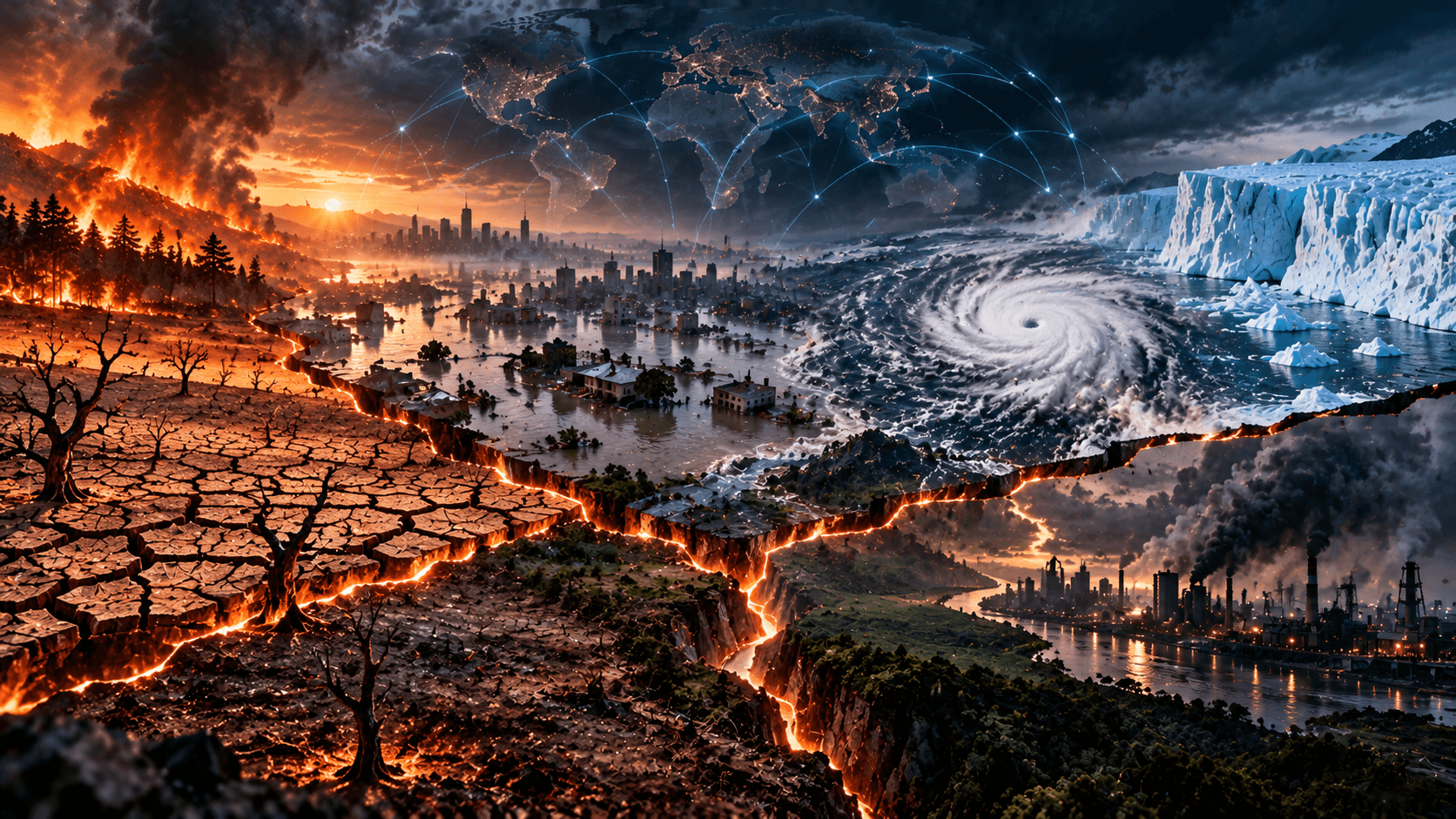
AI-generated illustration. Not a photograph of a real event.
For millions of families, the story of global instability is not a map of distant battlefields. It is a grocery receipt. A fuel pump. A car they can no longer afford to replace. A farm whose next planting season suddenly costs more than the last. The crises that created those pressures began in different places, for different reasons, in different years. Their consequences arrived at the same kitchen table.
The pandemic taught the first lesson. When COVID-19 shut factories, interrupted shipping and changed how people worked and shopped, production could not adjust as quickly as demand. The shortage of tiny semiconductor chips became a shortage of cars. An analysis published by the US Federal Reserve in September 2026 estimated that American vehicle production fell more than two million vehicles short of its pre-shortage baseline over 2021 and 2022. Automakers prioritized more expensive models as chips became scarce. Buyers faced thin inventories, long waits and higher prices, including in the used-car market. Source 1
The virus did not need to damage a single automobile to make a family’s next one less affordable. It only needed to interrupt a component on which the entire industry depended. Similar pressures affected electronics and other goods. The disruption revealed something modern prosperity had made easy to forget: efficiency and resilience are not always the same thing.
Then, in February 2022, Russia invaded Ukraine. Two major participants in global grain and agricultural markets were caught in a war that damaged production and trade. Russia was also a leading fertilizer exporter, and natural gas—already under pressure—was essential to manufacturing nitrogen fertilizer. The Federal Reserve Bank of St. Louis documented how the invasion aggravated shortages that had begun during the pandemic and helped drive fertilizer prices to record highs that spring. Source 2
For a farmer, fertilizer is not an abstract commodity. Neither is diesel. Diesel runs tractors, combines and trucks; fertilizer helps determine what the soil can produce. When both become expensive, the choices narrow. Plant less, borrow more, accept smaller margins or pass some of the cost forward. None of those choices stays entirely on the farm. They travel to processors, distributors, retailers and, eventually, the family trying to stretch its grocery budget.
By 2026, another war had struck a different link in the same chain. US and Israeli strikes on Iran began on February 28, followed by severe disruption to shipping through the Strait of Hormuz. The waterway is central not only to oil and liquefied natural gas, but also to the movement of fertilizer and the energy used to make it. As the conflict continued, fuel costs rose and fertilizer plants and shipping routes were disrupted. Source 3
The consequences were not confined to the Persian Gulf. In March, Reuters reported that fertilizer production disruptions were affecting global supplies ahead of spring planting, including rising costs for Canadian farmers. In October, a UN official warned that without agreement on fertilizer transit through Hormuz, some farmers in Asia and Africa could miss their planting seasons altogether. Source 3Source 4 A warship thousands of kilometres from a field could now influence whether that field received the inputs it needed in time.
And the price shock had already reached food markets. The World Bank reported that global food commodity prices rose approximately five percent in the two months after the Middle Eastern war began. That was smaller than the initial surge following Russia’s 2022 invasion, partly because grain supplies were comparatively strong. Source 5 But the protection offered by global inventories is uneven. A commodity index can stabilize while a household still struggles with a grocery bill shaped by years of accumulated price increases, wages, rent and local distribution costs.
That is what the phrase “cascading crisis” can conceal if we use it too casually. It is not a theoretical diagram. It is the family whose vehicle costs more because chips were scarce, whose food costs more after successive energy and fertilizer shocks, and whose savings have less room to absorb the next emergency. It is the farmer paying more to produce the food, and the consumer paying more to buy it, while neither feels better off.
These events were not caused by a single conspiracy, nor did every price rise have one explanation. Pandemic disruptions, demand shifts, corporate pricing, weather, government policy, energy markets and armed conflict all played different roles. Some shortages eased. Some commodity prices retreated. Those distinctions matter. But the larger pattern remains: societies can recover from one shock unevenly, and another shock can arrive before the recovery has reached the people least able to bear it.
Now consider what happens when these economic aftershocks meet the dangers explored throughout this series. A drought damages harvests while fertilizer remains expensive. A cyberattack interrupts a port during a shipping crisis. A flood closes roads when fuel deliveries are already strained. A hospital loses power when replacement parts are delayed. The emergencies may be unrelated at their source, but they draw upon the same transport networks, public budgets, workers, energy supplies and public trust.
Our institutions often name and manage these problems separately. Health officials confront disease. Defense ministries confront war. Farmers confront input costs. Utilities confront power failures. Families confront bills. Yet no family lives inside those administrative boundaries. The same household absorbs every consequence, and the same community must find the capacity to endure them all.
The most dangerous moment may not be the first shock. It may be the second, or the third, arriving after resilience has already been spent. A government can borrow to manage one emergency. A business can draw down inventory. A family can use its savings. But reserves are finite, and repeated crises can consume them faster than they can be rebuilt.
This is the threshold humanity must recognize. Not proof that every system will fail, nor a prediction that global collapse is inevitable. A warning, grounded in what has already happened, that the next catastrophe may strike a world still paying for the last one.
We do not have to imagine the first cracks. We have been living with their consequences for years. The question is whether we will strengthen what connects us before those cracks meet.
Sources and reporting notes
Reporting cutoff: October 25, 2026. Historical events are included to explain pressures active in 2026. Commodity price indexes are not identical to household retail food prices; examples of compound disruptions are explicitly hypothetical.
Source links open in a new tab.
- 1
US Federal Reserve, “When the Chips Went Down: Motor Vehicle Production and the 2021–2022 Semiconductor Shortages,” September 28, 2026.
- 2
Federal Reserve Bank of St. Louis, “How the Russia-Ukraine War Fueled Record Fertilizer Prices,” October 2022.
- 3
Reuters, “Gulf fertilizer plants go dark as Iran war chokes global supply ahead of spring planting,” March 17, 2026 (republished by Canadian Cattlemen).
- 4
Reuters, “Failure to activate Hormuz fertilizer plan could trigger food crisis, UN official says,” October 14, 2026.
- 5
World Bank, “Food prices feel the heat as war in the Middle East rattles commodity markets,” 2026.