The World TodayArticle 10 of 12
The Price of Waiting
Every warning carries a decision. The most dangerous one may be to do nothing.
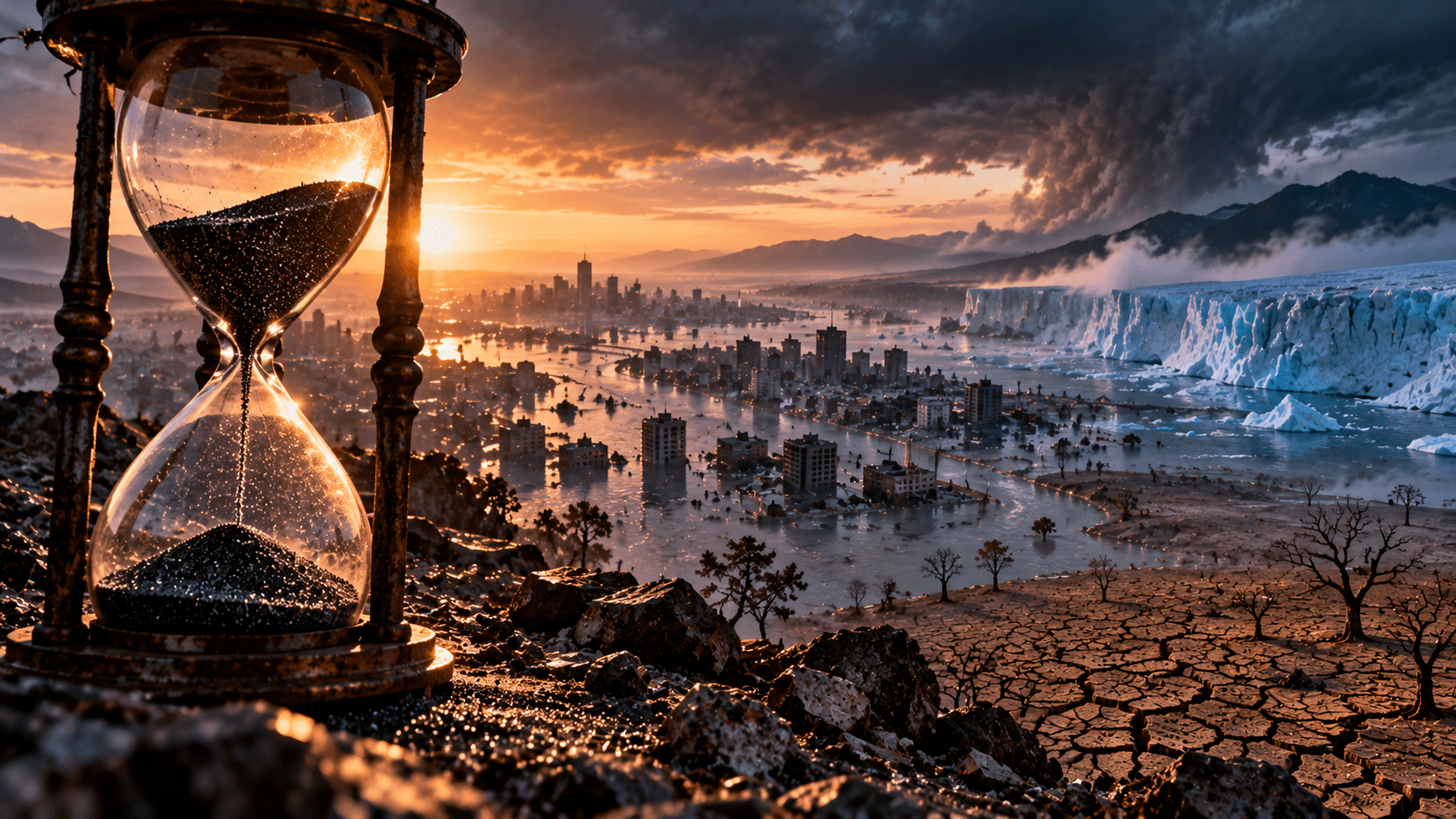
AI-generated illustration. Not a photograph of a real event.
There is a particular kind of comfort in believing that someone, somewhere, is in charge. When war expands, diplomats will contain it. When crops fail, markets will adapt. When the power goes out, engineers will restore it. When a new technology grows too powerful to understand, its creators will surely know when to stop.
Each assurance has a basis in experience. People do negotiate peace, repair grids, move food and prevent disasters. But reassurance becomes a danger when it hardens into an excuse for inaction—when we mistake the existence of institutions for proof that those institutions will always have the time, resources and public trust to succeed.
The world of 2026 was not short of warnings. In June, the Food and Agriculture Organization and World Food Programme identified 13 hunger hotspots where acute food insecurity could worsen in the months ahead. These were not distant predictions of some imaginary century. They concerned people already confronting war, displacement, failing livelihoods and barriers to aid. Source 1
Warnings like that are easy to misunderstand. They do not mean that every threatened outcome is certain. They mean that choices still matter. Access can be opened or blocked. Funding can arrive or disappear. A ceasefire can hold or fail. The tragedy is not that the future is unknowable. It is that uncertainty so often becomes permission to delay.
Consider what a modern emergency asks of a government. It needs functioning roads, reliable power, working communications, hospitals, fuel, supplies and people willing to follow credible instructions. It needs money, but also the ability to spend it honestly and quickly. It needs expertise, but also public confidence in that expertise. Most of all, it needs time.
Now imagine that time being taken away from several directions at once. A military confrontation interrupts a shipping route just as drought reduces a harvest. A storm damages an electrical network while hospitals are already stretched. False information races through a population precisely when accurate instructions could save lives. None of these links is inevitable. All are plausible mechanisms by which a manageable emergency could become something far larger.
And yet the systems that connect us also give us reasons to underestimate our exposure. A household far from a battlefield may never see the fighting, only the rising cost of fuel or food. A family far from a floodplain may never see the water, only the shortage of medicine whose delivery route has been cut. Distance can hide a crisis long after its consequences have begun to travel.
The International Monetary Fund’s October 2026 outlook still projected global economic growth. That is an important fact: a strained world is not the same as a collapsed one. Source 2 But a global average cannot tell us whether a particular family can afford groceries, whether an isolated hospital has enough supplies, or whether a government has reserves left for the next emergency. Aggregate resilience and individual catastrophe can exist side by side.
There is another temptation: to treat each warning as the responsibility of a separate specialist. Military officers handle deterrence. Scientists handle climate. Regulators handle technology. Aid agencies handle hunger. Engineers handle infrastructure. Each field needs deep expertise. But a crisis does not respect the organizational chart created to manage it.
When a war drives energy costs higher, the consequences move into agriculture and transport. When an extreme-weather event forces people from their homes, the consequences move into housing, health and politics. When confidence in institutions erodes, even well-designed emergency measures can become harder to carry out. The connections are not hidden. What remains too often missing is the willingness to treat them as one shared responsibility.
And responsibility is not confined to presidents, generals, chief executives or international agencies. Their decisions carry extraordinary weight, and they must be held to account. But citizens also shape what leaders can ignore. We decide which suffering remains visible, which evidence deserves scrutiny, which institutions are pressed to explain themselves, and whether the needs of strangers count when they compete with our own convenience.
That does not mean ordinary people can personally end wars or control the weather. It means that resignation is not the same as realism. Demanding transparent decisions, investing in resilient communities, supporting credible reporting and insisting that emergency systems work before they are tested are not grand gestures. They are the unglamorous foundations of collective survival.
Perhaps the greatest error is to imagine catastrophe as a single dramatic moment: the first missile, the first failed harvest, the first city without power. In reality, the decisive moments may arrive earlier and pass almost unnoticed—in postponed repairs, ignored warnings, weakened safeguards, hollowed-out public services and opportunities for cooperation that were allowed to expire.
By the time a crisis becomes impossible to ignore, many of the choices that could have contained it may already be gone.
We have spent nine articles looking at dangers that appear to belong to different worlds. They do not. They meet in the systems that feed us, protect us, inform us and allow us to trust one another. The next question is not whether every warning will come true. It is what happens if several do, before we have dealt with the first.
The world does not have to end because we failed to predict the future. It may be enough that we recognized the risks, called them someone else’s problem, and waited.
Sources and reporting notes
Reporting cutoff: 25 October 2026. Hypothetical combinations of crises are identified as possibilities, not events that have occurred. No invented interviews or eyewitness accounts appear in this article.
Source links open in a new tab.
- 1
FAO and World Food Programme, Hunger Hotspots: early warnings on acute food insecurity (June–November 2026), 17 June 2026.
- 2
International Monetary Fund, World Economic Outlook, October 2026.