The World TodayArticle 09 of 12
When Trust Became the Casualty
A society can survive disagreement. It becomes vulnerable when disagreement turns into the conviction that no one outside its own circle deserves to be believed—or helped.
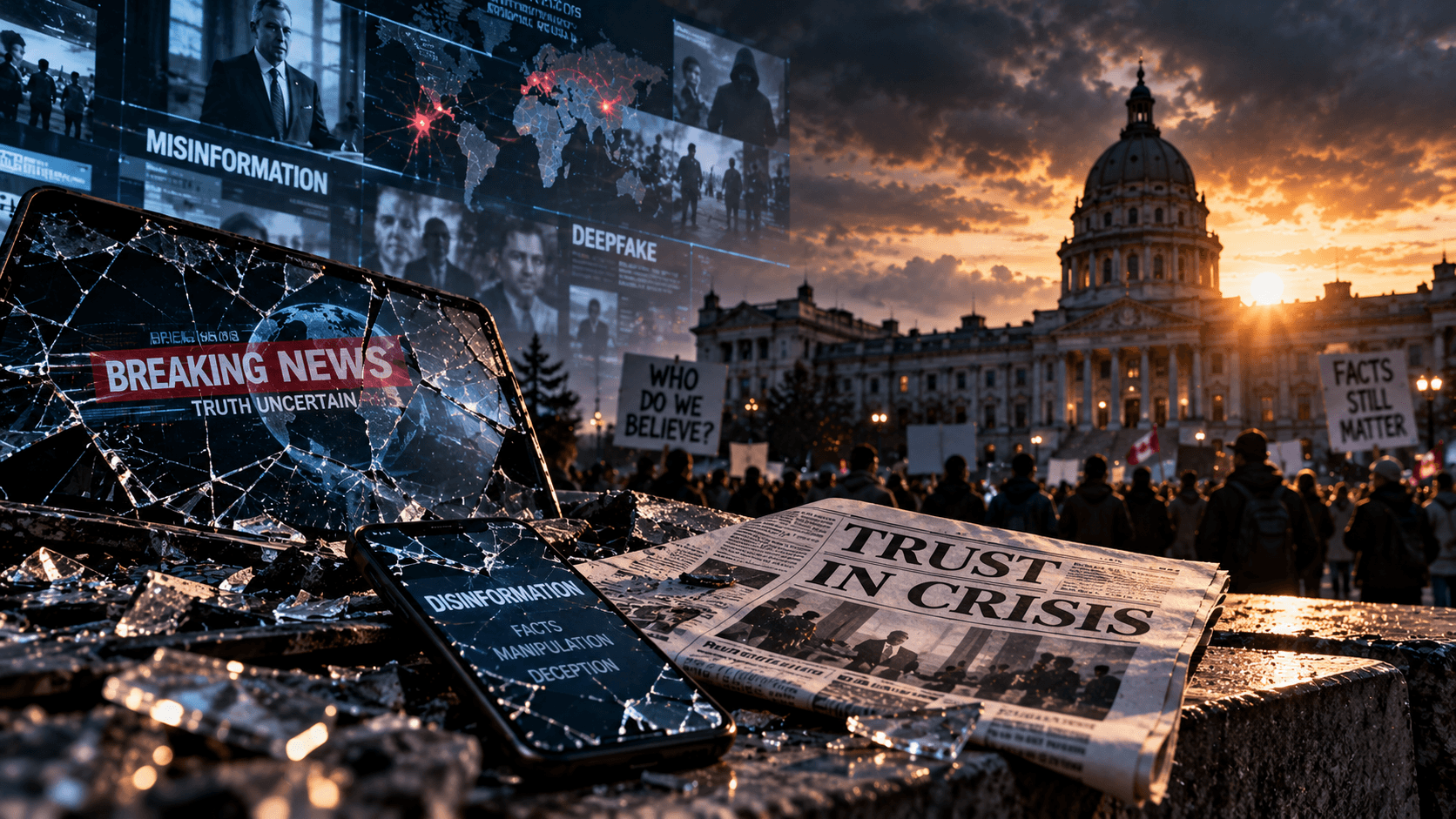
AI-generated illustration. Not a photograph of a real event.
The first casualty of a crisis is not always a life, a building or a border. Sometimes it is the simple belief that the stranger standing beside us is part of the same human community.
It happens quietly. A warning arrives and is dismissed because it came from the wrong institution. A neighbor asks for help and is judged by a flag, a faith or a political allegiance. A public official makes an urgent appeal, but half the people listening suspect deception before the first sentence is finished. In a functioning society, distrust is a problem. During an emergency, it can become a danger of its own.
By 2026, that danger had become measurable. In Edelman’s annual trust survey, seven in ten respondents across 28 countries said they were unwilling or hesitant to trust people whose values, information sources, backgrounds or approaches differed from their own. In Canada the figure was 73 percent; in Germany, 81 percent; in Japan, 90 percent. The survey was conducted in late 2025 and published in January 2026, and its wording measures attitudes, not actual behavior in a disaster. Still, it describes a troubling instinct: as the world grows more uncertain, many people are drawing the boundaries of trust ever tighter. Source 1
Consider what that means when a community needs to evacuate, distribute scarce supplies or share accurate information about a dangerous event. The question is no longer only whether the warning is correct. It becomes who delivered it, whose interests they represent, and whether the people next door deserve a place in the response.
And there are reasons people have become suspicious. Governments have concealed failures. Companies have placed financial interests ahead of public welfare. Institutions have spoken with more certainty than the evidence justified. Corruption, misinformation and unequal treatment have given many citizens grounds to demand better. Skepticism is not the enemy of democracy. Accountability depends upon it.
But there is a dangerous point at which skepticism stops asking for evidence and begins rejecting the very possibility of shared evidence. Every photograph becomes a forgery, every correction a cover-up, every opposing voice an enemy. When that happens, a society can possess the information it needs to protect itself and still be unable to agree on what it means.
The consequences extend beyond arguments on a screen. Freedom House reported in March 2026 that political rights and civil liberties had declined globally for the twentieth consecutive year, based on its assessment of 2025. Fifty-four countries registered deterioration and thirty-five improvement. Its classifications involve judgments that should be scrutinized, but the underlying pattern points toward growing pressure on independent institutions, civic freedoms and the checks that make abuses harder to hide. Source 2
Where those checks weaken, the consequences can become self-reinforcing. Citizens lose confidence that rules apply equally. Leaders begin to regard criticism as disloyalty. Public institutions grow less capable of correcting mistakes. The people who most need protection become least certain that anyone will provide it. Fear encourages withdrawal, and withdrawal makes the next emergency harder to manage.
This is not merely a domestic problem. International cooperation also depends on trust: that agreements will be honored, that warnings will be shared, that aid will reach those in need, that an adversary’s next move can be interpreted without immediately assuming the worst. When states increasingly treat every dependency as a vulnerability and every concession as defeat, diplomacy becomes harder precisely when it is most necessary.
The World Economic Forum’s 2026 global risk survey ranked societal polarization and misinformation among the leading near-term concerns, alongside geoeconomic confrontation, interstate conflict and extreme weather. Its findings represent the judgments of surveyed experts, not a prediction of what must happen. But their proximity on the list is revealing. The threats do not sit in separate rooms. Polarization can undermine the response to a flood; disinformation can poison a ceasefire; distrust can turn a public-health warning into a political test. Source 3
Imagine a city where the power fails during a winter storm. Repair crews need access to damaged lines. Emergency officials need residents to conserve supplies. Hospitals need patients to follow instructions. Families need to believe that shelters are safe. None of those tasks can be completed by electricity, technology or government authority alone. They require people to cooperate with others they may not know and may not like.
Now imagine that every request is interpreted as manipulation, every rumor spreads faster than a correction, and every neighborhood decides its own survival matters more than anyone else’s. The storm has not changed. The damage has. A crisis that might have been contained becomes harder to endure because the human relationships needed to contain it have already been weakened.
It would be a mistake to romanticize trust as blind obedience. The institutions that ask for confidence must earn it through honesty, competence and accountability. A society that cannot question its leaders is not resilient. But neither is a society in which no one believes anyone, no evidence can settle a dispute, and every emergency becomes another contest over identity and power.
The warning is not that disagreement will destroy us. Disagreement is unavoidable, and sometimes essential. The warning is what happens when we stop recognizing obligations to people beyond our own side—when the circle of those we are willing to protect becomes smaller than the scale of the dangers we face.
We have built a world in which a failure thousands of kilometres away can affect the price of food, the security of a hospital, or the safety of a family. Our problems are interconnected whether we like it or not. Our loyalties, increasingly, are not.
And that may be among the most dangerous contradictions of this era: humanity has never depended more upon cooperation, while so many of us are being taught to regard one another as the threat.
Sources and reporting notes
Reporting cutoff: 25 October 2026. Survey results describe stated attitudes, not observed emergency behavior. Institutional indices and expert surveys involve methodological choices; they are evidence of measured trends and perceptions, not proof of future collapse.
Source links open in a new tab.
- 1
Edelman, 2026 Trust Barometer (published January 18, 2026; fieldwork October–November 2025).
- 2
Freedom House, Freedom in the World 2026 (published March 2026; assesses 2025).
- 3
World Economic Forum, Global Risks Report 2026 (January 14, 2026; expert risk-perception survey).
https://www.weforum.org/publications/global-risks-report-2026 (opens in a new tab)