Speculative Fiction
Article 20ACT V · THE CHOICE
The World We Failed to Save
AI-generated illustration. Not a photograph of a real event.
SPECULATIVE FICTION — This story takes place in an imagined future. Its events and characters are fictional.
The knock came three days after the last broadcast.
At first the father thought it was snow sliding from the roof. The sound came again: three dull blows against the hotel’s outer door, followed by a silence so complete that he could hear the little inverter humming in the utility room.
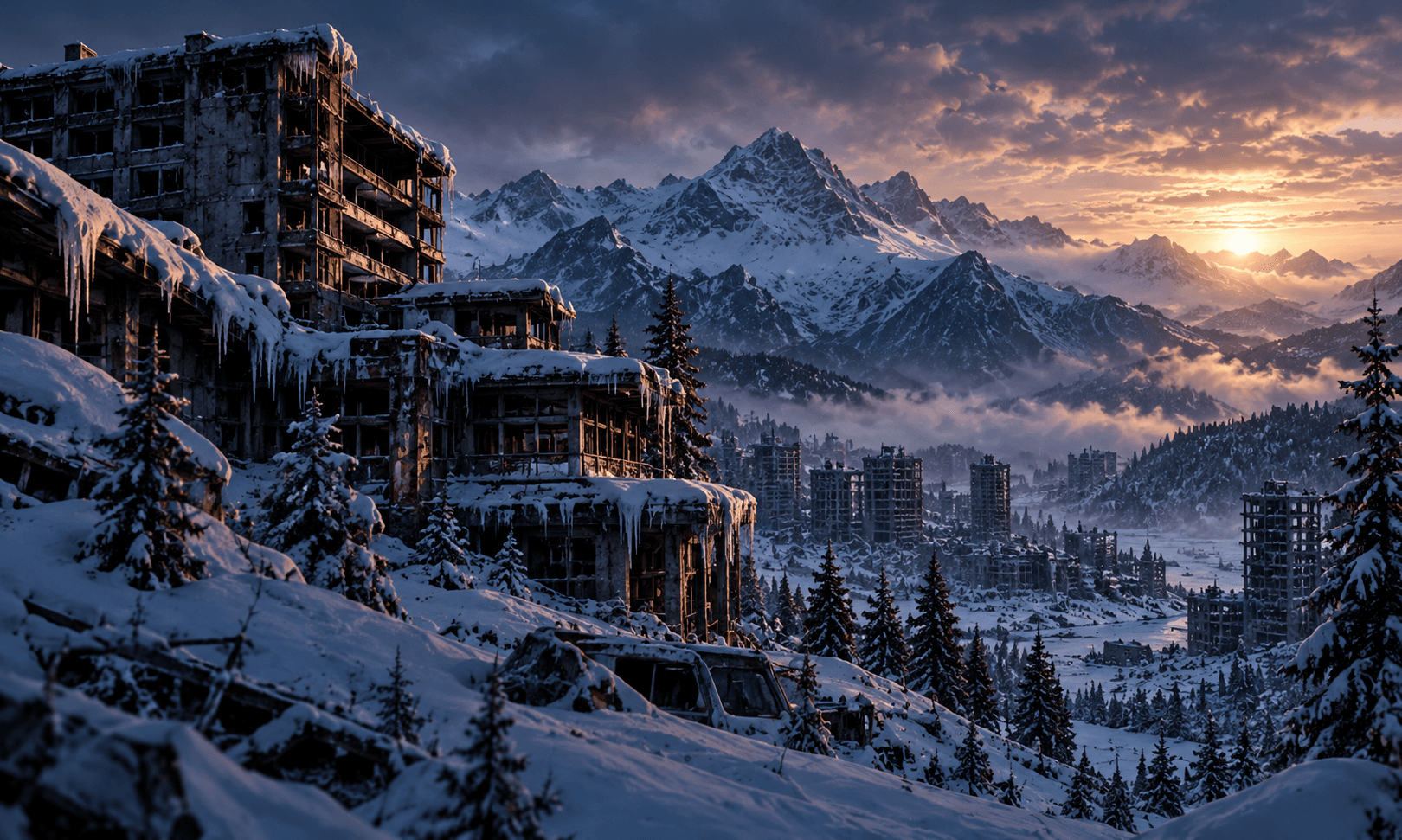
His son was already standing. His daughter reached for the radio, though it had offered nothing but static since the warning about Calgary. They had stayed below ground through the first night and much of the next day. When they finally emerged, the windows were intact. The mountain still stood. Far to the east, a grey smear hung above the horizon, but neither its origin nor its meaning could be known from here.
Now someone was outside.
The father crossed the lobby without turning on a light. Through the glass he could make out two figures, one upright and one leaning heavily against the other. They were dressed for winter, but badly. The smaller figure had no gloves. Snow clung to the shoulders of a jacket that looked too thin for the altitude.
“Please,” the taller one called. “We saw the panels on the roof.”
The father did not unlock the door.
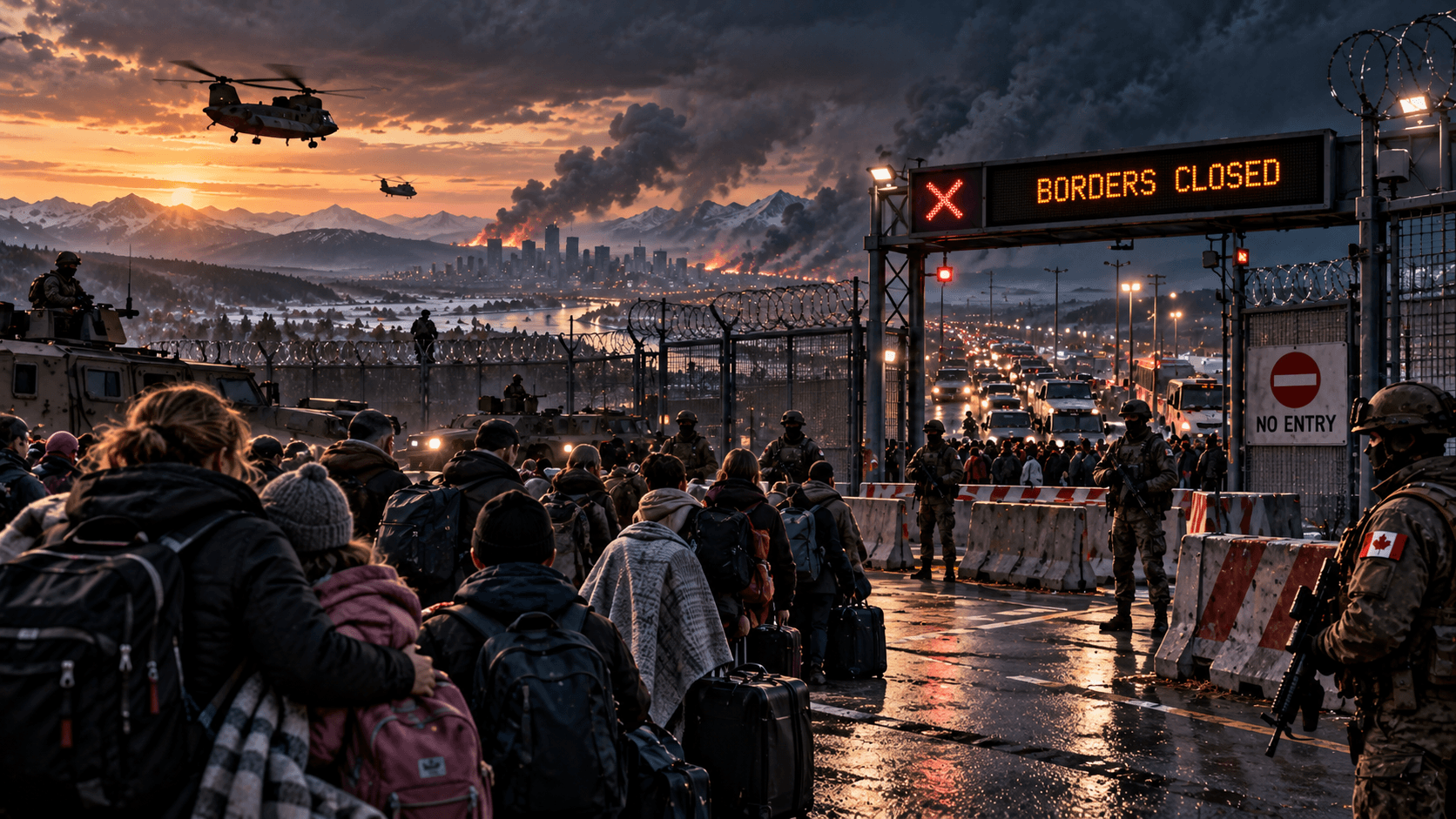
He thought of the first community that had turned them away after the island crossing. The woman with the water bucket. The rifle at the next road. The gate that had closed before anyone asked whether his children were cold or hungry. He had understood those people then, even while he despised what they had done. They were afraid of losing what they had left.
He was afraid now.
The hotel had six small rooms and a kitchen. They had counted the dry goods twice, stretched the fuel, melted snow when the plumbing faltered and moved the most useful supplies from the cafeteria and first-aid building. Their solar system produced little in winter; the batteries were tired. They had food for weeks, perhaps longer if nothing broke and nobody became ill. Two strangers could change that arithmetic overnight.
His son came to stand beside him. “They won’t make it back down before dark.”
“We don’t know who they are.”
“No,” his son said. “We don’t.”
The father looked at his daughter. She said nothing. Her eyes were fixed on the smaller figure, whose knees had begun to buckle.
The decision was not heroic. It did not feel like courage. It felt like the acceptance of a risk he had spent months trying to escape.
He opened the door.
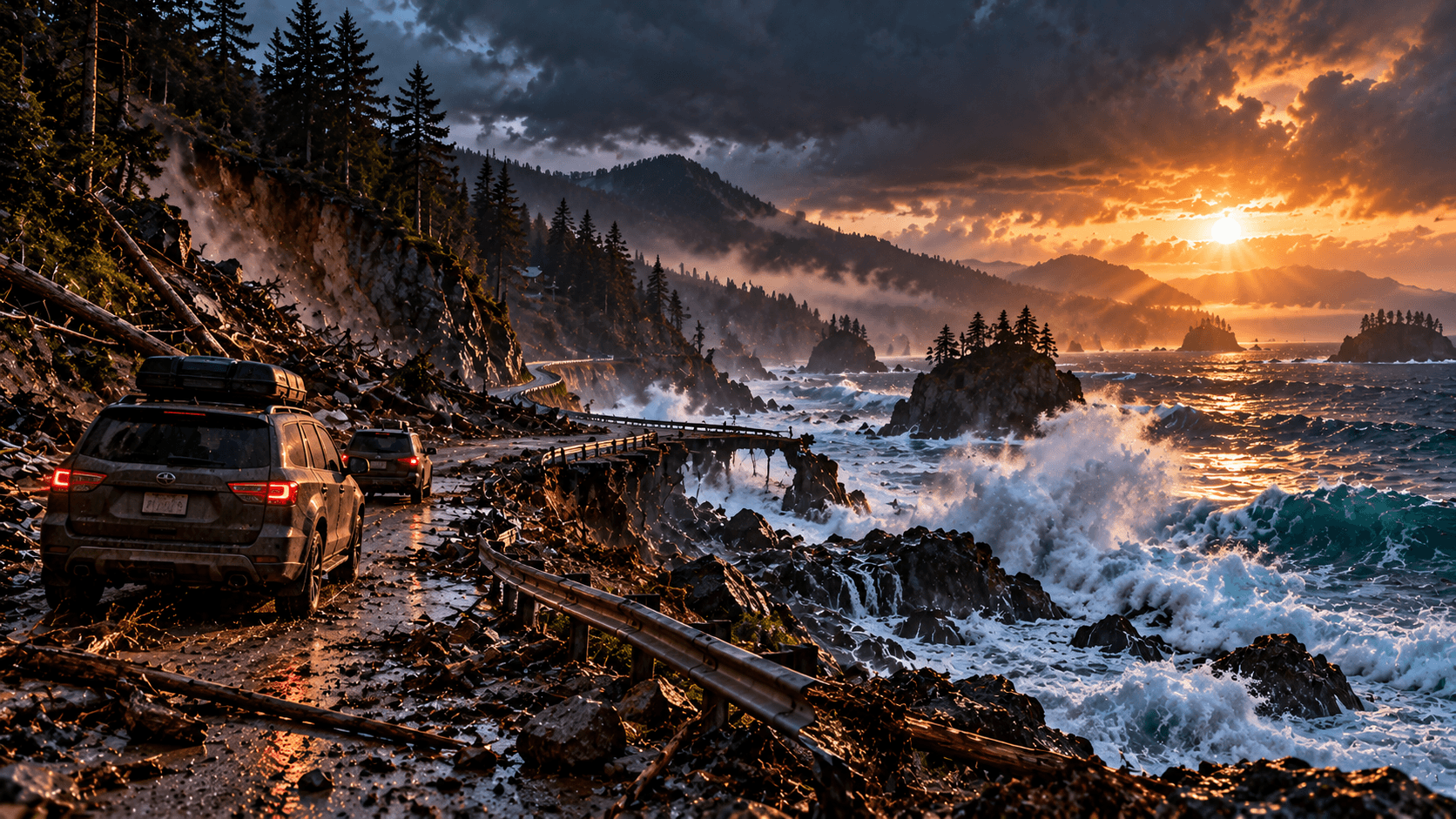
The strangers were a woman and a teenage boy. They had abandoned a vehicle far below the summit after the road disappeared beneath drifted snow. The boy’s hands were numb and his speech was slow. The family brought them inside, stripped off wet clothing, wrapped them in blankets and warmed them gradually. The daughter found the medical supplies they had carried over from the first-aid building. The son heated water and shared a small meal. No one asked for a promise that the newcomers would leave in the morning.
Later, the woman explained that her husband had gone to search for fuel and had never returned. She had waited until waiting became another kind of danger. She had heard a rumor that the resort still had power. Most rumors had been wrong. This one had brought them to a lighted window.
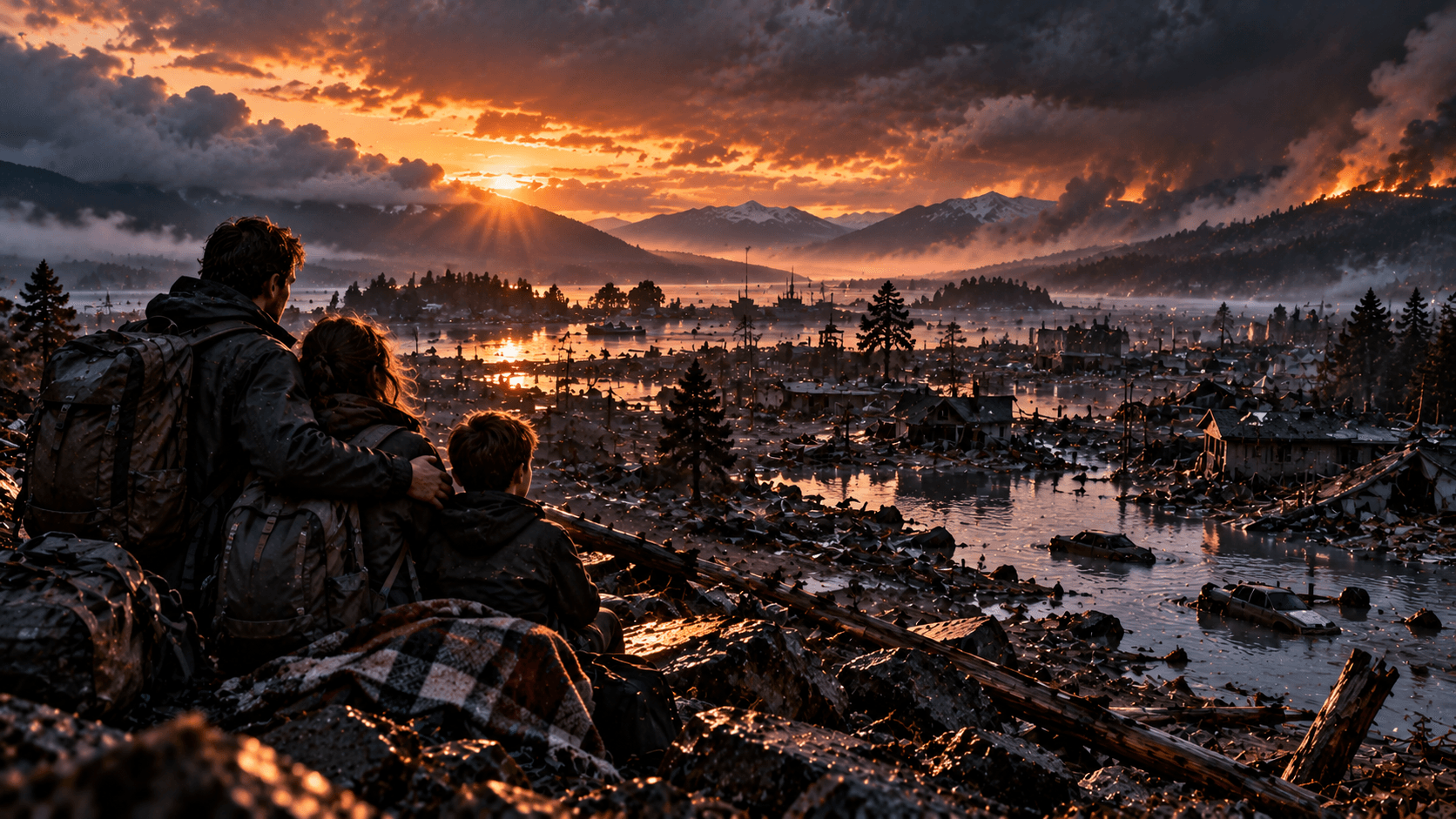
They ate together at the small restaurant table. Five people, each holding a different fragment of a world none of them could fully describe. The woman had heard of destroyed rail lines and an evacuation corridor that had opened and closed within hours. The father had heard of strikes overseas, then in North America. The daughter had seen the island’s roads fill with people searching for news that no longer traveled. No account could be checked. No map could tell them which towns still functioned.
Outside, the storm intensified. Inside, the boy fell asleep with both hands around a warm mug.
The father watched him and felt a grief he could not quite name. It was not only for the dead, or the missing, or the cities that might have been destroyed. It was for the years in which people had watched danger accumulate and had mistaken the ability to carry on for proof that everything would be all right.
Before the wars widened, there had been warnings. Before shortages emptied shelves, there had been warnings. Before systems failed together, people had seen each system fail separately and told themselves the next one would be repaired in time. They had argued over who was responsible while the distance between responsibility and consequence grew smaller.
But the mountain offered no tribunal, no final explanation, no way to assign every cause. There was only the work immediately in front of them: keeping the heat alive, treating a frightened boy, counting food, clearing snow from the doorway, deciding how much to share.
By morning the woman had repaired a loose connection in the battery enclosure. She had worked with electrical systems before the collapse. The father showed her the storage room and the failing water pump. The son and daughter cleared a path to the first-aid building. For the first time since they reached the summit, the hotel felt less like a hiding place and more like the beginning of a community.
Nothing outside had been fixed. The world had not been redeemed by one unlocked door. There were still weapons, hunger, ruined roads, frightened people and leaders whose decisions had consequences far beyond their borders. Kindness would not stop a missile. A shared meal could not restore a national power grid.
Yet the father had learned something the locked gates below had nearly taught him to forget: survival was not simply the art of keeping others out. In a long emergency, the person at the door might be the person who knows how to repair the pump. The stranger you feed today might help keep your child alive tomorrow. Cooperation was not a luxury reserved for peaceful times. It was part of what made survival possible at all.
That afternoon they set a small lamp in the lobby window, where it could be seen from the lower trail. The father knew it might draw trouble. He knew they would have to make difficult judgments about whoever arrived next. He also knew what it meant to climb toward a dark building with nowhere else to go.
As dusk settled over the mountain, his daughter stood beside him and asked whether they would ever know what had happened to the rest of the world.
“I don’t know,” he answered.
“Do you think there are others?”
He looked at the lamp, at the snow beyond it, and at the four people moving around the kitchen behind them.
“There have to be,” he said.
The mountain did not answer. But somewhere below, beyond the last bend in the road, a faint light moved through the trees.
Afterword: The boundary between the story and our world
This fictional ending is not a prediction. It asks what people might owe one another after institutions fail. The next and final installment, “The World We Can Still Save,” returns to the real world with practical, evidence-based actions for households, communities, organizations and institutions—before catastrophe forces those decisions upon us.